And I'm not talking the variety with nuts and candied fruits.
I probably shouldn't have answered my phone at 7 a.m. during my Christmas break, but what the hell. I did.
And now I have officially undergone a rite of passage for every woman in our society: the pervert prank caller.
I suppose some people might have been outraged or highly flustered to have someone they don't know whisper, "What kind of panties are you wearing?" at 7 a.m. over the phone. I was more having to hold back all sorts of colorful comments, things like, "It's flippin' 7 a.m., what the hell do you think I am wearing?" or "No man, what are YOU wearing?"
And to make matters worse, I was immediatly transported to that scene in Mel Brooks' "High Anxiety," when Madeline Kahn thinks someone has made a similar call to her. "I know a lot of the other girls are turned on by these sort of kinky phone calls, but I really couldn't care less ... what are you wearing? Jeans? I bet they're tight."
Of course, good judgement prevailed and I said nothing and hung up. I eventually had to unplug the phone because he kept calling. The dude must have been really desperate for some phone sex or something. Like, has he never heard of the Internet?
I now feel I am finally part of the common experience. Wow. Thanks pervert dude.
;-)
Share on Facebook
Friday, December 29, 2006


Holiday midway
Past Christmas and not quite New Year's. Sounds like the perfect time for a greeting.
Happy holidays, all!
Share on Facebook
Happy holidays, all!
Share on Facebook
Monday, December 18, 2006
Wisdom of a Whitney mix
I always find something that fits.
"This is hell, this is hell
I am sorry to tell you
It never gets better or worse
But you get used to it after a spell
For heaven is hell in reverse."
-Elvis Costello, "This is hell"
Share on Facebook
"This is hell, this is hell
I am sorry to tell you
It never gets better or worse
But you get used to it after a spell
For heaven is hell in reverse."
-Elvis Costello, "This is hell"
Share on Facebook
Monday
Alarm buzzing.
Eyeballs open.
Shower too short.
Kids fighting.
Cold car.
Late for school.
Windy walk to the office.
Irritating e-mails.
It's not even noon and already my jaw hurts from clenching. This could be a loooong week.
Share on Facebook
Eyeballs open.
Shower too short.
Kids fighting.
Cold car.
Late for school.
Windy walk to the office.
Irritating e-mails.
It's not even noon and already my jaw hurts from clenching. This could be a loooong week.
Share on Facebook
Sunday, December 17, 2006
Sucks having a Satan mother
I've finally reached the end of my proverbial rope with my middle child, who has had a week to clean her room. Today, after six hours of time to clean her room and do what amounted to one sink full of dishes, I was dismayed to find that she had accomplished almost nothing. So I made good on my promise and now every one of her toys and other belongings is in plastic garbage bags. No crap. No crap to pick up, right? Alas, instead of being thrilled with this wonderful reprieve from cleaning she has received, her only response was two words (punctuated with lots of screaming and crying):
"You suck."
Share on Facebook
"You suck."
Share on Facebook
Chocolate casualty
I am perhaps the only person I know who can injure themselves while making candy. Note to self: Using your full body weight to bust a bar of dipping chocolate in half is extraordinarly painful when said bar breaks and said full body weight is brought down on the tip of your thumbnail.
Share on Facebook
Share on Facebook
Tuesday, November 28, 2006
Some people watch football
Not my family. Our holiday traditions involve lower temperatures and more clothing. Lots more clothing. Add this to the file that proves my rugged Alaska womanhood. Or something like that.

No, we aren’t dead. No, we haven’t fallen and can’t get up.
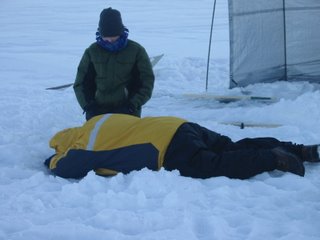
No, I am not an extreme example of that kid in elementary school that licked the monkey bars. Mmmm. Lake ice. You see, underneath our faces is a hole in the ice. We are simply paying very close attention to our baited hooks, waiting for the big strike ...
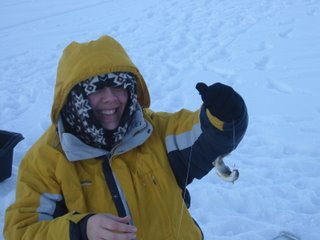
Aha! Victory at last.
 The boy fared a little better, though I still say that in fishing, the gross weight of the fish isn’t the true measure of success. Nope. The fun’s in the catching, right? So every fish counts, right? Right? So, according to my calculations, I caught exactly 50 percent of the fish that day.
Share on Facebook

No, we aren’t dead. No, we haven’t fallen and can’t get up.

No, I am not an extreme example of that kid in elementary school that licked the monkey bars. Mmmm. Lake ice. You see, underneath our faces is a hole in the ice. We are simply paying very close attention to our baited hooks, waiting for the big strike ...

Aha! Victory at last.
 The boy fared a little better, though I still say that in fishing, the gross weight of the fish isn’t the true measure of success. Nope. The fun’s in the catching, right? So every fish counts, right? Right? So, according to my calculations, I caught exactly 50 percent of the fish that day.
Share on Facebook
I'm good enough, I'm smart enough and doggone it, people like me!
My 12-year-old son pointed out my pinochle shortcomings this weekend with the following phrase, uttered at the beginning of what would go on to be the sixth or seventh game in a row that my sister creamed my dad and me:
"Failure to succeed will commence."
Share on Facebook
"Failure to succeed will commence."
Share on Facebook
Sunday, November 19, 2006
I can’t take the suspense

The above appears on the roof of a local coffee stand.
How can they do such a thing to all of us. Bagel sandwich’s what? How can we go on not knowing the rest of the sentence? It could be something scandalous like, “Now serving bagel sandwich’s secret desires.” It could be valuable information that could change my life, a la “Now serving bagel sandwich’s easy ways to get rich quick. No punctuation required.” The words “bagel sandwich’s” could be more than just the simple personification of baked goods. What if “bagel sandwich” is really a code word for some super -secret important person?
How can I go on not knowing? I curse you, damned bagel sandwich. Your secrets shall remain forever unknown.
Share on Facebook
Tuesday, November 07, 2006
The Big (virtual) I
Looking for results? Visit the Division of Elections online. Not quite as fun as multicolored copies in a wire basket, but pretty darn close.
Share on Facebook
Sunday, November 05, 2006
Is it just me, or is everything buzzing?
The recipe
One triple-shot vanilla latte
One grande chai latte
One 16-ounce caramel latte
One Diet Pepsi
The result
Blogging at warp speed. Like, akin to Beavis. Heh hehehehe. Fire! Fire! Fire!
And you thought it was impossible to mix Star Trek and that infamous MTV animated classic.
“Hey Beavis ... Engage.”
Share on Facebook
What’s a voter to do?
I’m just a mess about Election Day. It’s a nearly impossible scenario:
We have one D, one R and one I (for independent).
So, say your worst fear is that Candidate D wins. You would ordinarily lean toward the Candidate R, but you also really like many of the things Candidate I has to say. Still, you know Candidate I, being outside our lovely two-party system, will not likely win and will instead serve as a spoiler either for Candidate R or Candidate D. But the problem is, Candidate I used to be part of the R party, but in some ways speaks like a D.
In order to ensure that Candidate D doesn’t win, whom do you vote for? Do you vote for Candidate I, who perhaps would be the best choice of the three? If you do that, and every vote for Candidate I takes a vote away from Candidate R--your second choice--then you are helping to elect Candidate D. But if you vote for Candidate R, are you missing the chance to elect the person you think would really be best for the job?
I predict that many people will be very angst-ridden at the ballot box, myself included, whether they favor Candidate D, R or I. That or I am overanalyzing things again.
Share on Facebook
Too much past blast
Be warned that my young adult life had a decidedly daytime-drama air to it, but my visits from the ghosts of upheavals past this evening were a bit more than I can process at once.
First, it’s pick my kids up at the ex’s trailer, where he lives with the woman who worked for me in high school, who he was dating before we met and who was, for a while after we were married, driving by our house at odd hours.
And if that’s not bad enough, I’m happily standing at the UScan checking out my small basket of groceries when a friendly “how are you doing” reaches my ears. I look up and see the friendly, smiling faces of two people, a couple, I knew when we were all teens. Awww. Nice. Sweet. Yeah, except the deal is that I know him because I had a six-month-long torrid relationship with him. I know her because she is the girlfriend he was “in the process of breaking up with” the whole time. (Note that these two are married now.) I know both of them because they are the ones who eventually ended with misdemeanor convictions for beating the crap out of me after school.
Hi, how are you doing? Whoa! Overload. I mumbled something pleasant and laughed nervously and then left. What the heck are you supposed to say? “Hi! How are the kids? You still wearing those strange, shiny underwear?”
Yeah. I always think of the best things to say after the fact.
Share on Facebook
Mergers, diversification and other secrets of romance
I have a dear friend who would argue that relationships between two people--marriage, for instance--are more business deals than anything else. And we have delightful verbal tangos on the issue, with him telling me that I’m a sap (I am) and me telling him he often has the romantic inclinations of a fencepost (he does).
Now in many ways, this friend is correct. From a financial standpoint, a married couple will almost always have more potential for income than a single person. They live together in one house, pay one set of the expenses of living, and generally take advantage of that proven truth of business known as economy of scale. Though it isn’t in any written contract, many of the interactions of marriage resemble what one might see in a relationship between two businesses. If you cook dinner, I’ll do the dishes. If you work full time, I’ll work part time and take care of all of the household duties. It even enters into the most intimate parts of a relationship. Almost every couple who has been together for any length of time is familiar with bedroom bargaining.
So you have financial incentives, de facto contracts and heated bargaining. Sounds like business, no?
It does. But there’s one thing you throw into the equation and it taints the brew, so to speak, and calls into question the businesslike appearances of many relationships: love.
Go ahead, get all the eye-rolling and the “yep, she’s a sap,” stuff out of your system. Go ahead. I’ll wait.
OK, here’s my point:
In my opinion, love is solitary in nature and therefore independent of any business deal. You either love someone or you don’t. Love may grow or fade over time, but it either is or it isn’t. And it is not part of any reciprocal arrangement. There is no, “I’ll love you this much if you love me in return to an equal degree.” If you love someone, it really doesn’t matter whether they love you back or not. Their ability to do so has absolutely nothing to do with your own feelings. I think most people would agree that the statement, “I love you because you love me,” is loaded with all sorts of psychological dysfunction and is not something any of us would strive for. No, the best we can do is to say, “I love you regardless” and then hope for the best. That’s why loving relationships--whether they be a marriage or a friendship or a family--can be frightening at times. That’s why they are so rewarding when they work. That’s why their demise is so traumatic.
In the end, despite all of the wheeling and dealing, we are left only with the enormity of our unconditional love for another human being and the realization that we alone must deal with all that follows. You can’t hire out that task.
Bottom line: Business is dependent on reciprocity. The core of human relationships isn't.
Share on Facebook
Friday, November 03, 2006
Friday morning poetry
Sometimes, the spam in my inbox is nearly poetic in its oddity:
Everything grows: your body, experience,
sexual desire but not your penis. Advanced Gain Pro
will make the last one grow too.
Advanced Gain Pro can enlarge your dick so
much that you won’t be scared of ruler anymore.
Try Now very cool
Sexual innuendo, random capitalization, badly translated language. What's not to love?
Share on Facebook
Wednesday, October 18, 2006
History in the making?
A while back, I watched an online animation about the future of the press. You can watch it here.
The basic gist is that several mergers of online giants like Google and Amazon, combined with technology that allows people to create their own news portals, basically made the concept of news a self-selecting enterprise. For example, if you wanted to select, say, only information about pro wrestling and the latest on Pamela Anderson, then that is what would show up each day as the top news. Nothing about Korea. Nothing about a national election. Nothing about crime rates in your town skyrocketing. Only pseudo-athletes and big breasts.
In this futuristic world, what we now know as the giants of the fourth estate have become bankrupt and obsolete. Nobody reads the New York Times or listens to APRN. They simply get their “news” spoon-fed to them via the billions of self-proclaimed “journalists” across the Web. There is not even a baseline assurance that the things that you read are true or well-researched or created with any eye toward basic journalistic ethics. Everyone creates the news. The line between the journalist and the wingnut down the street is gone. The concept of balanced reporting is gone. If you want to hear only that all gay people are evil perverts, then you can set your channels to feed you gobs and gobs of diatribes to reinforce your bigotry on a daily basis.
I can’t help but wonder how close we are getting to this place. And I should state up front that I am a journalist by training and may be a bit snobbish about the journalist’s role in society. Still, the bottom line to this scenario, and to a certain degree this holds true even today, is that people seem to be growing less and less informed. And the scary thing is that they seem to be choosing to become that way. It’s ironic that in this age of so much information, people seem to have less information about things that are important. Perhaps it’s a consequence of information overload.
At any rate, I wonder if this scenario has ever played out in modern human history. What happens to a society that chooses to be ignorant of the things that allow it to govern itself wisely? Certainly we have plenty of examples of authoritarian regimes that block out their citizens’ access to information, but has there ever been a country where the people actually chose to simply look away, where people, even though they could learn about the important things in their society, simply say, “You know, I don’t really feel like it.”
Are we choosing the path to our own destruction?
Share on Facebook
Tuesday, October 03, 2006
Innocence slipping
My 12-year-old son has always been a lot more insightful about human behavior than he ought to be at his age, so I guess our conversation tonight shouldn’t come as a huge surprise to me. Still, it says a lot about all of us when a seventh-grader picks up on the hypocrisy around him.
Our conversation began with him bemoaning the fact that some of the kids on his basketball team were giving him a hard time, telling him he is no good, etc. That was hard enough to hear, since I remember how damn hard middle school was. The worst thing was hearing him say, “The thing is Mom, is if you tell on them or they get caught, it really doesn’t do any good, because they don’t care about the consequences. They probably do get in-school suspension, but they don’t care. Their parents all just come in and say, ‘it was some other kid’s fault’ and the principal maybe believes them. And even if the principal doesn’t believe them, the kids don’t get into any trouble from their parents because their parents believe that their kid didn’t do it.”
What the heck do you say to that last statement? I make it a practice not to lie to my kids about the way the world works and I have to say that, in a lot of cases, he is spot on. I did mention the whole, “You have to live with yourself and your behavior at the end of the day” thing, which I believe strongly in, being a great avoider of guilt. Still, pretty sad that a 12-year-old observes this phenomenon that so many adults are blind to.
Share on Facebook
Wednesday, September 27, 2006
'Its' just hilarious
What do you think it says about someone that said person thinks it's amusing to stand in front of a fridge rearranging the magnetic words and inserting apostrophes where they don't belong a la "It's hinges are so rusted its difficult to open."
Hee hee hee. I mean, that person is just sick. Sick, I tell you. And so is my--I mean that person's--copy editor friend. Freaks.
Share on Facebook
Hee hee hee. I mean, that person is just sick. Sick, I tell you. And so is my--I mean that person's--copy editor friend. Freaks.
Share on Facebook
Tuesday, September 26, 2006
No undergrad left behind
I have this uneasy feeling that higher education is about to go the way of K-12.
By that I mean, “Hello, I’m from the federal Department of Education and I’m here to make sure that YOU are accountable.”
And when I say “accountable,” I mean, “Let’s see how much money we can suck away from the classroom to create a huge bureaucracy to administer tests that we have engineered to tell us absolutely nothing.”
Hmm, not sure where that vitriolic rant came from. Years of repressing my true feelings in print, I suspect.
Anyway. “All Things Considered” had an interesting interview with Education Secretary Margaret Spellings this evening. In it, she spoke about a recently released report from the Commission on the Future of Higher Education. You can hear the full interview here but the message I got out of it was that higher education needed a few things, among them more money for scholarships, more information for parents and students about the education they are purchasing and more accountability for the money the federal government puts into higher education.
All of these things sound fine on their face, just as they did when officials said similar things during the genesis of NCLB. I mean, really, who can oppose things like students learning and public entities spending our money wisely?
But, a couple of things she said made me shudder. First, Michele Norris asked her whether she was advocating testing in higher education. Her answer was to say that she wouldn’t advocate a one-size-fits-all test. The inference here was that the universities or states should decide what type of evaluation system works best for them.
Then later in the interview she said that the federal government needed to offer higher education “incentives and assistance” to meet the challenges detailed in the report.
I’ll go out on a limb here and translate. Keep in mind this is my opinion and is filtered through my more-cynical-than-is-healthy brain, but try this one on for size:
Dear Higher Education (I capitalized that because people in higher ed REALLY like to capitalize things);
Since our recent report found that you are lacking in several areas, we are here to offer you some incentives and assistance to move to a new and exciting age in education.
First, we want you to develop a set of assessments. We’ll tell you what to include in them, what it takes to pass them and how often you have to give them, but we DO NOT want a one-size-fits-all test.
Please develop a large and expensive bureaucracy to administer this new testing system. We can’t afford to give you all the money to pay for this new department, but I’m sure you can find some money in your budget somewhere. Just so you won’t feel alone, we’ll do the same.
Once the testing system is in place, we’ll move on to how to bring every student up to 100 percent proficiency, but that’s a memo for another day.
Oh yes, I did mention incentives, didn’t I? Of course, we wouldn’t expect you to do this without some incentive. How’s this: Do it or we‘ll jerk your funding.
Love and kisses,
U.S. Department of Education
Whack me upside the head with a piece of celery if I’m wrong. I even have one you can borrow. I smell a changing tide in higher education, and if it’s anything like what NCLB is doing to K-12, it’s low tide in Ketchikan when the humpies are running. (Just ask someone who has lived there.)
Share on Facebook
Subscribe to:
Posts (Atom)